


Hope you all had a great holidays and are feeling refreshed for 2026!
Over the holidays, I read way too many prediction posts and synthesized the common themes I’m seeing across all of them.
This week, I'll be covering the theme of generalists & agency. Next week, in Part 2, I’ll talk about the year of AI agents.
Trend #1: AI-enabled generalists
A new superpower is emerging: the AI-enabled generalist.
These aren’t “AI experts”. They’re people who can:
Manage AI systems
Deploy them into workflows
Apply them to new problem spaces
And connect dots across domains
Jack Clark, co-founder of Anthropic, wrote about this in his recent Substack post:
"if you can manage some humans so they’re more effective, you can probably build a framework to elicit better capabilities out of any AI system”
Later, he doubles down:
“humans who are good at managing other humans and codifying the management processes they use are likely well positioned to build elicitation frameworks to supercharge the performance of today’s AI systems”
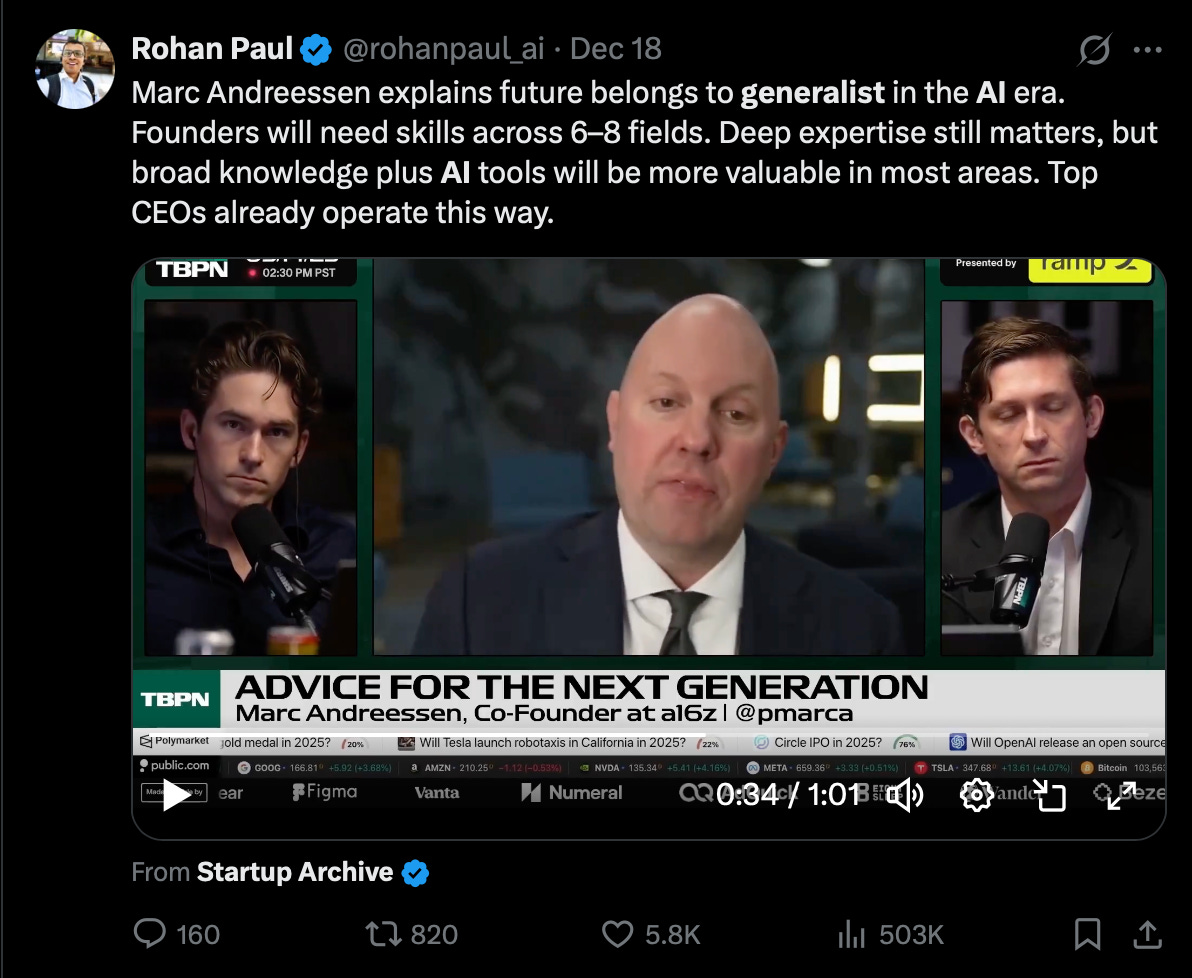
Marc Andreessen, co-founder of a16z, echoed a related idea when he stated that the best founders will have deep skills across 6-8 different areas.
Emphasis on deep skills.
Deep skills, not just “dabbling at”, but an expectation to be really, really good at 6-8 different areas.
AI-enabled generalists will thrive in this environment where learning new skills is nearly free. All you need is the agency to self-teach yourself new skills.
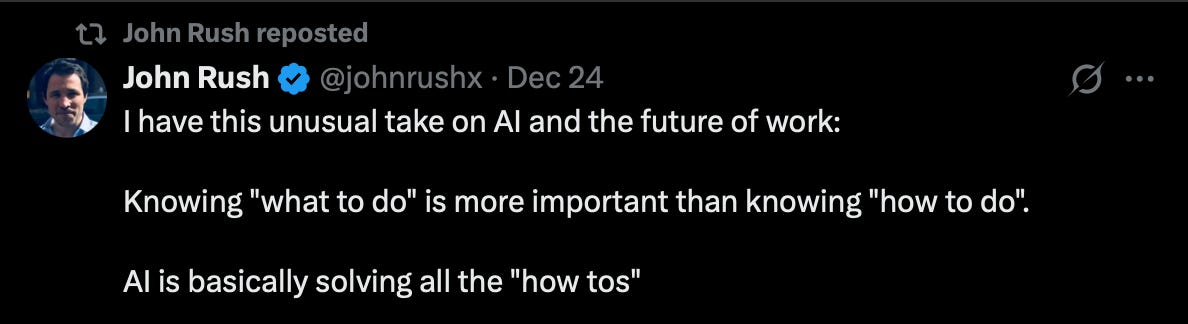
Another framing of this trend is that because AI is taking care of all the “how-tos”, humans must get even more crisp on vision and strategy. In this post on the future of work, John Rush advises anyone whose job focusses on “how-to’s” to move into “why” work ASAP.
Similarly, in Rohan Paul’s post on X, he shared an interview Jensen Huang recently did about poorly defined work.
Poorly defined work will be where humans make the most impact because defined work is easy for AI to execute on.
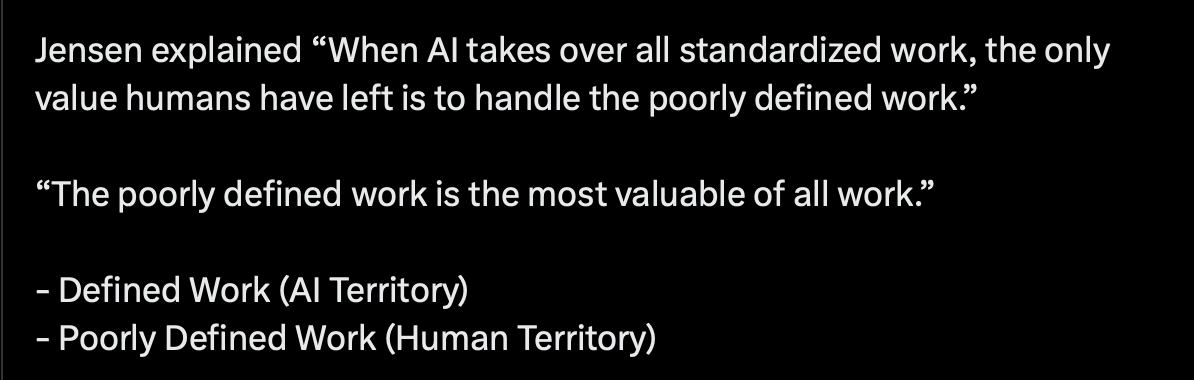
Generalists will thrive in this new arena because they’re comfortable with poorly defined work: work without clear inputs, outputs, or playbooks.
Generalists, enabled by AI, will have the breadth across domains to figure things out, while those with narrow expertise used to task-based work may struggle.
What this means for Product Builders:
Lines between product, design, and engineering will continue to blur and Product Builders will be expected to be fluent in all domains
PMs will be expected to be “AI-native” by default
Learning new domains becomes table stakes, agency to self-teach is key
Vibe coding becomes an everyday tool
Communicating why, not just what, becomes your biggest lever as a PM to help your team navigate “poorly defined work”
Trend #2: The Renaissance Developer
In his 2026 predictions article, Werner Vogels (Chief Technology Officer at Amazon.com) wrote about the emergence of the Renaissance Developer.
The fundamentals that have always made great developers remain unchanged. But like the great thinkers of the Renaissance who refused to be confined to a single discipline, developers can no longer live in silos.
Similar to the generalist trend, developers of the future will be fluent in many different domains. AI handles much of the mechanical coding. What will differentiates builders is:
Domain understanding
Product taste
Systems-level thinking
I also saw an interesting framing from a Linkedin creator, Fru Nde, stating that there will be a delineating from developers vs. engineers.
Developers = anyone who can build with AI tools
Engineers = those who think about architecture, tradeoffs, and systems

This trend is driven by AI-assisted coding doing most of the heavy lifting. Lee Robinson, a Cursor educator, talked about this in his latest video, where he encourages engineers to focus on learning UX, product thinking, distribution, and marketing the product.
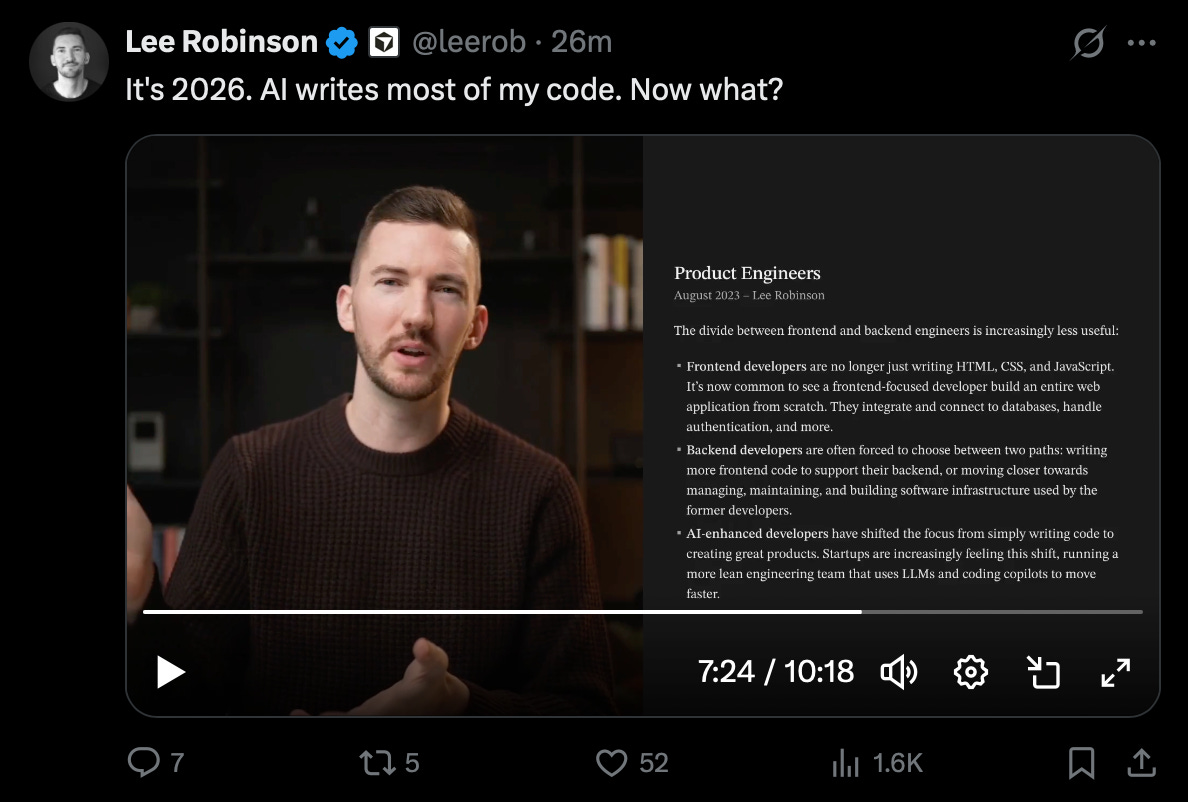
This quote from his 2023 blog is now more true than ever:
AI-enhanced developers have shifted the focus from simply writing code to creating great products.
The Renaissance Developer will need to be a generalist too: fluent in UX, product marketing, distribution, and have great design taste.
What this means for Product Builders:
If you’re a PM, this is the year to collaborate with your engineering team even more on the end-to-end product lifecycle: from idea generation to distribution
Builders who develop business intuition and design taste will stand out
Product sense becomes as important as technical fluency
How to stand out in 2026
The big theme I’m seeing for this year is: agency.
Agency to learn.
Agency to master new domains.
Agency to experiment with new AI tools.
Agency to self-teach yourself new ways of working.
The ones who redefine their role instead of defending it will lead this next year.
💬 Leave me a comment: what topics do you want to hear about in 2026?