


Salesforce made one of the most important product moves of the year: they introduced a headless version of their platform.
Less than a year ago, Salesforce was actively restricting API access by tightening control over how developers and external systems interacted with its ecosystem.
Now, they’re doing the exact opposite: opening the door for their product to be accessed via APIs, MCP, CLI for agents.
That’s not just a feature update. That’s a strategic reversal which all SaaS products should pay attention to.


Early on, Bill Gurley called this open data vs. closed data, but now the industry is framing this as headless software.


At the time Salesforce was concerned about blocking AI rivals access to Slack data, but the reversal now comes because agents are replacing the user interface entirely.
If a behemoth like Salesforce is willing to “let go” of users interacting with their UI, what happens to every other SaaS product?
The headless SaaS imperative
In a series of tweets, Aaron Levie, CEO of Box, gives 2 main reasons headless software is a do-or-die for any SaaS company.
Agents will use more software than humans, so all SaaS providers will need to become agent-accessible or risk obsolescence.

This claim is backed up by software investment firm Thoma Bravo’s hypothesis that the agentic AI software layer will actually increase the software spend, not decrease it.
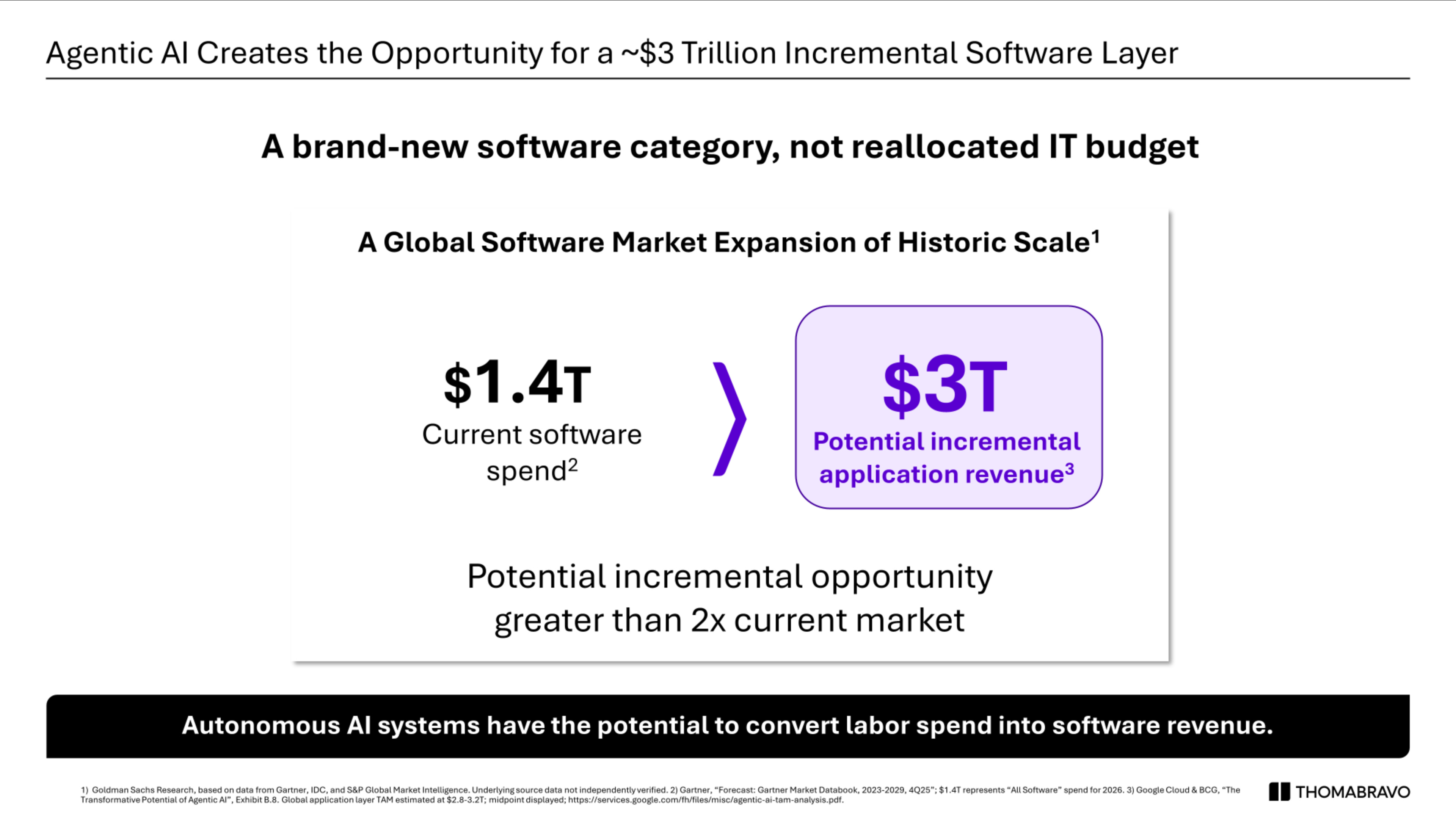
In order to future-proof their tech stack, enterprise buyers are increasingly asking: “will this product still be usable when agents are running our workflows?”. Think about it: no IT buyer wants to purchase SaaS that will later become obsolete because it’s inaccessible to agents.
 Aaron Levie@levieThe more I meet enterprise CIOs and AI leaders outside of tech, the more it’s obvious that if you’re building software that doesn’t have a great headless mode, you’re going to be at risk in the coming years. Asked a group of 20 IT leaders across banking, media, finance, and12:20 AM · Apr 11, 2026 · 78K Views45 Replies · 43 Reposts · 467 Likes

How do SaaS companies stay competitive?
But here’s the uncomfortable truth: becoming “agent-accessible” is not a moat.
Every SaaS company will realize they need to build MCP/CLI or die.
What will sustained, competitive advantage look like, and what moats should Product Builders be investing in?
This is where most builders are still thinking too shallow. The advantage doesn’t come from access alone.
The advantage will come from vertical and industry-specific expertise.
Vertical-specific models
There is still some debate on how defensible vertical-specific AI models are, because the general purpose models like Claude, Gemini, and ChatGPT get more impressive with each iteration.
In this article, Sandhya Hegde from Calibre Labs points out that if your model is trained with highly proprietary data (like Intercom’s Fin model, trained on 40 million customer service conversations), the competitive advantage can be sustained.
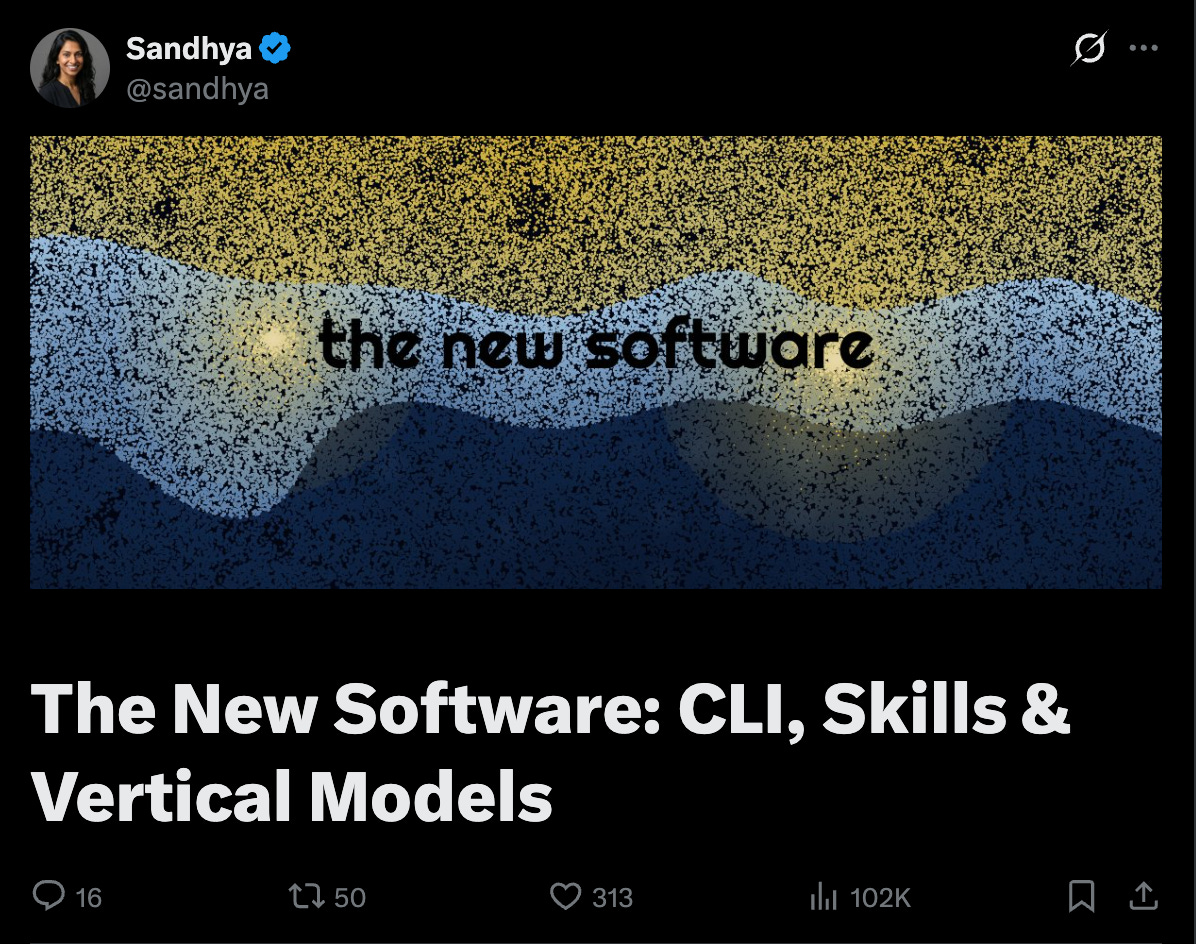
Her recipe for a a defensible SaaS company involves:
enabling your product for agent orchestration via CLI +
developing highly-specific skills files +
vertical-specific models.
But without vertical-specific models, the advantage cannot be sustained for long.
Complex workflows > simple apps
Another angle for Product Builders to look from is what investors look for when investing in SaaS.
In Thoma Bravo’s investor meeting, they presented an investment thesis that there’s actually 2 types of SaaS businesses, and they are important to distinguish. I’ll paraphrase and summarize them as:
“Simple SaaS”: companies with “generalist knowledge domains, simplified workflows, light regulatory oversight and limited switching costs”
“Complex SaaS”: “deep domain expertise, zero-tolerance-for-error workflows and embedded cross-system integration”.
This is the difference between a company like Salesforce and Monday.com: Monday.com being an example of a simple SaaS, whereas Salesforce being highly complex, deeply integrated and used by highly-regulated industries.
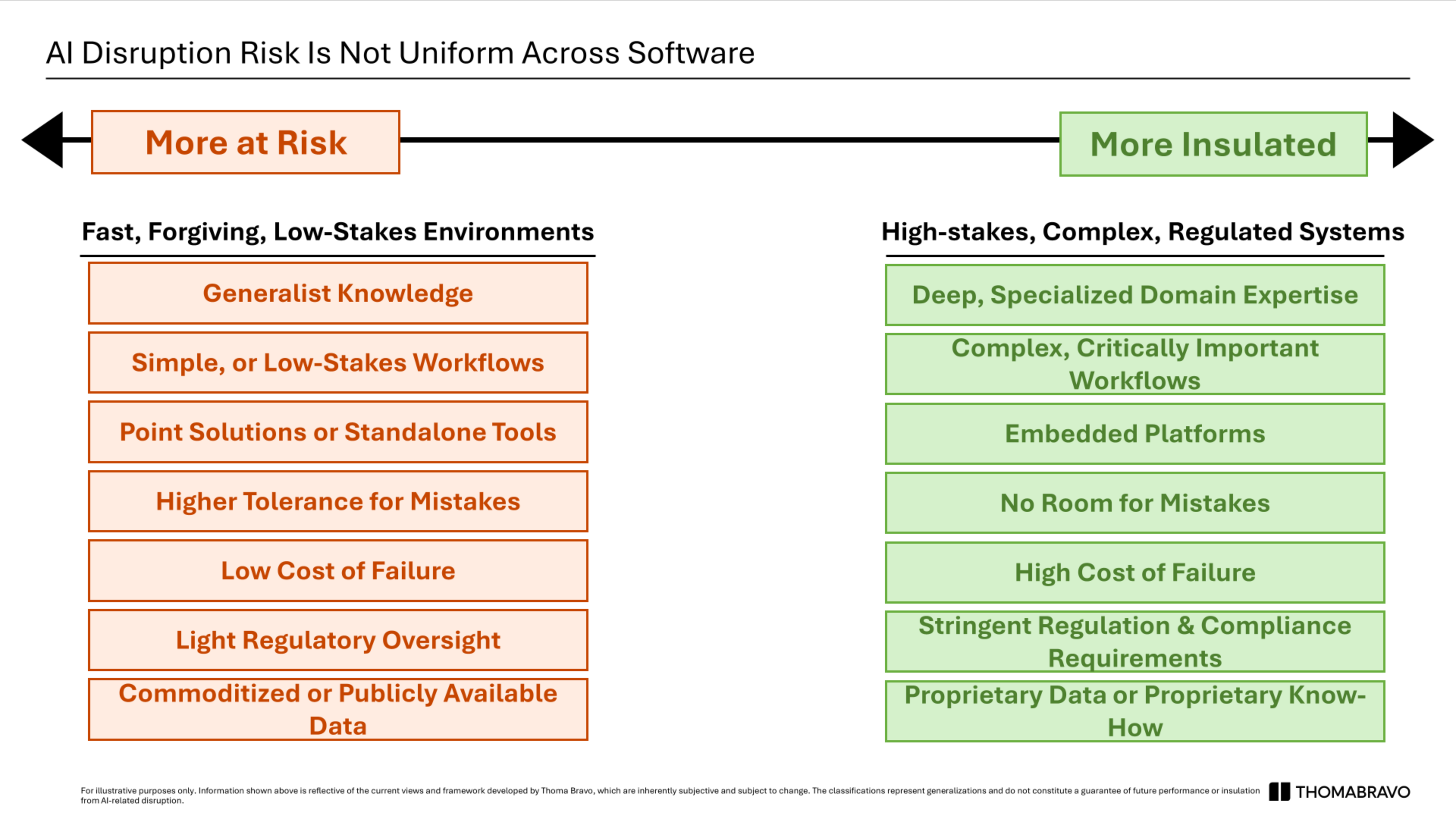
This is great news if you’re in a SaaS company that’s tightly integrated with a highly-regulated industry.
If you’re in a “simple SaaS” company, it’s time to specialize or risk dying.
The more complicated, the better
This is the opposite of what product builders have been told for the last decade. We’ve been trained to simplify UX, simplify workflows, and abstract complexity. But in the agent era? A simple app can be replicated in a weekend. An industry-specific, complex app creates a multi-year moat.
If you’re building a SaaS product from scratch, here’s some inspiration:
Lastly, if you’re an entrepreneurial Product Builder, here’s some inspiration that takes into account there principles.
Many early Product Builders are vibe coding apps that are way too simple: note-taking apps, meditation apps, and personal productivity apps. There will be no sustainable competitive advantage in these apps.
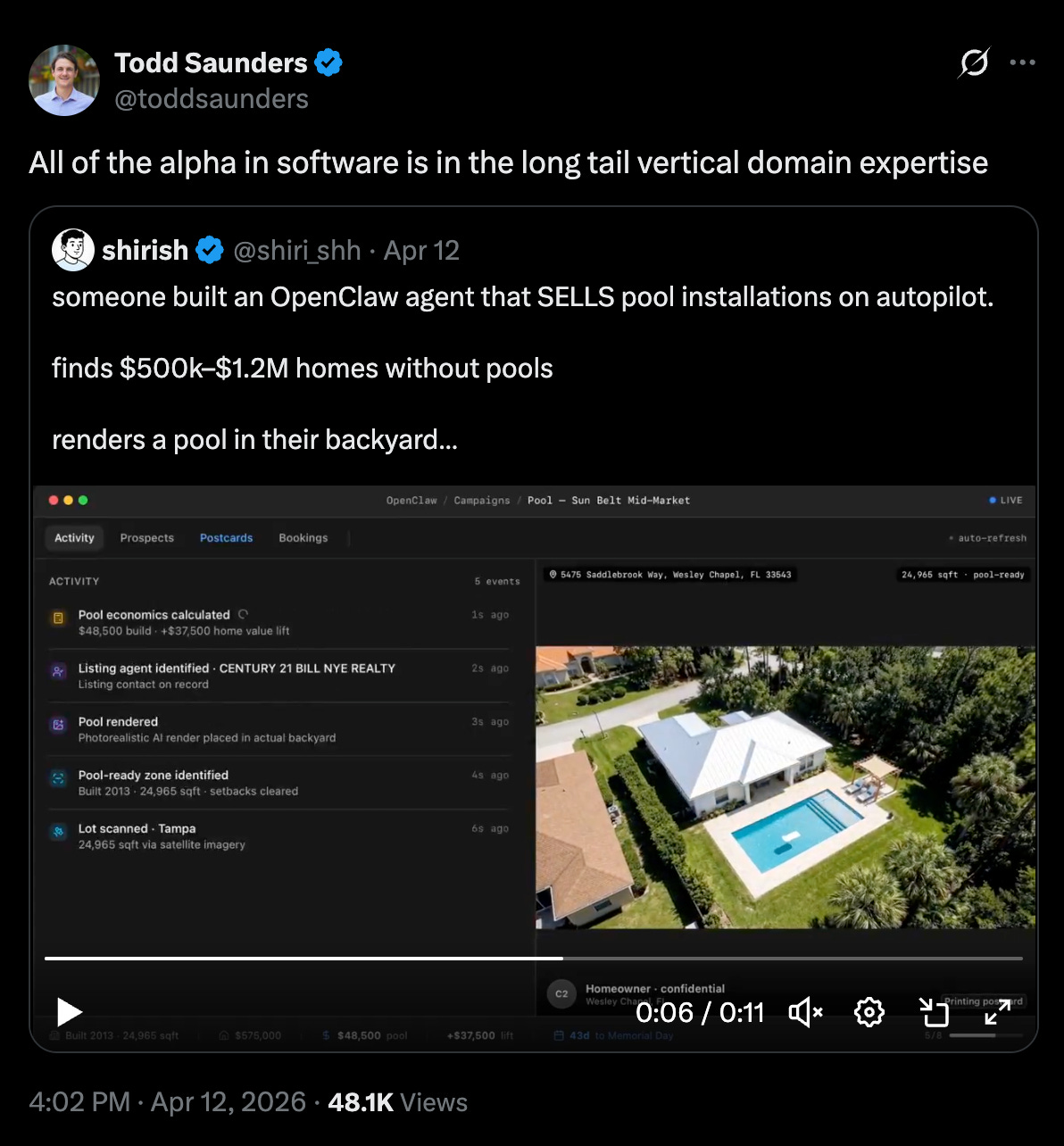
All of the “alpha” or “value” will come from highly-specialized use cases, like this workflow example where an OpenClaw agent renders pool installations and does cold outreach to homeowners. The workflow becomes a “business in a box”, not just another replicable SaaS app.
Final Thoughts
If you’re building SaaS, the time to advocate for agent experiences is now.
But agentic, headless software will become table-stakes, fast.
After that, vertical-specific expertise, complex and industry-specific workflows (the more complicated, the better) will win.
The winners will be the companies that go deeper:
deeper into data
deeper into workflows
deeper into edge-cases
deeper into highly-regulated industries