


You’ve probably seen Shopify’s impressive data visualization project: the annual 3D globe that visualizes Black Friday Cyber Monday sales from Shopify merchants.
This year, the 3D globe is more epic than ever before:
There’s the classic 3D globe that shows orders per minute, sales per minute, and unique shoppers
Confetti goes off when a merchant makes their first sale
An interactive pinball machine…just for fun
A “computer” with engineering, design, and data notes from the team that built it
Hidden easter eggs to unlock more fun features like a rainbow ball tail for the pinball machine
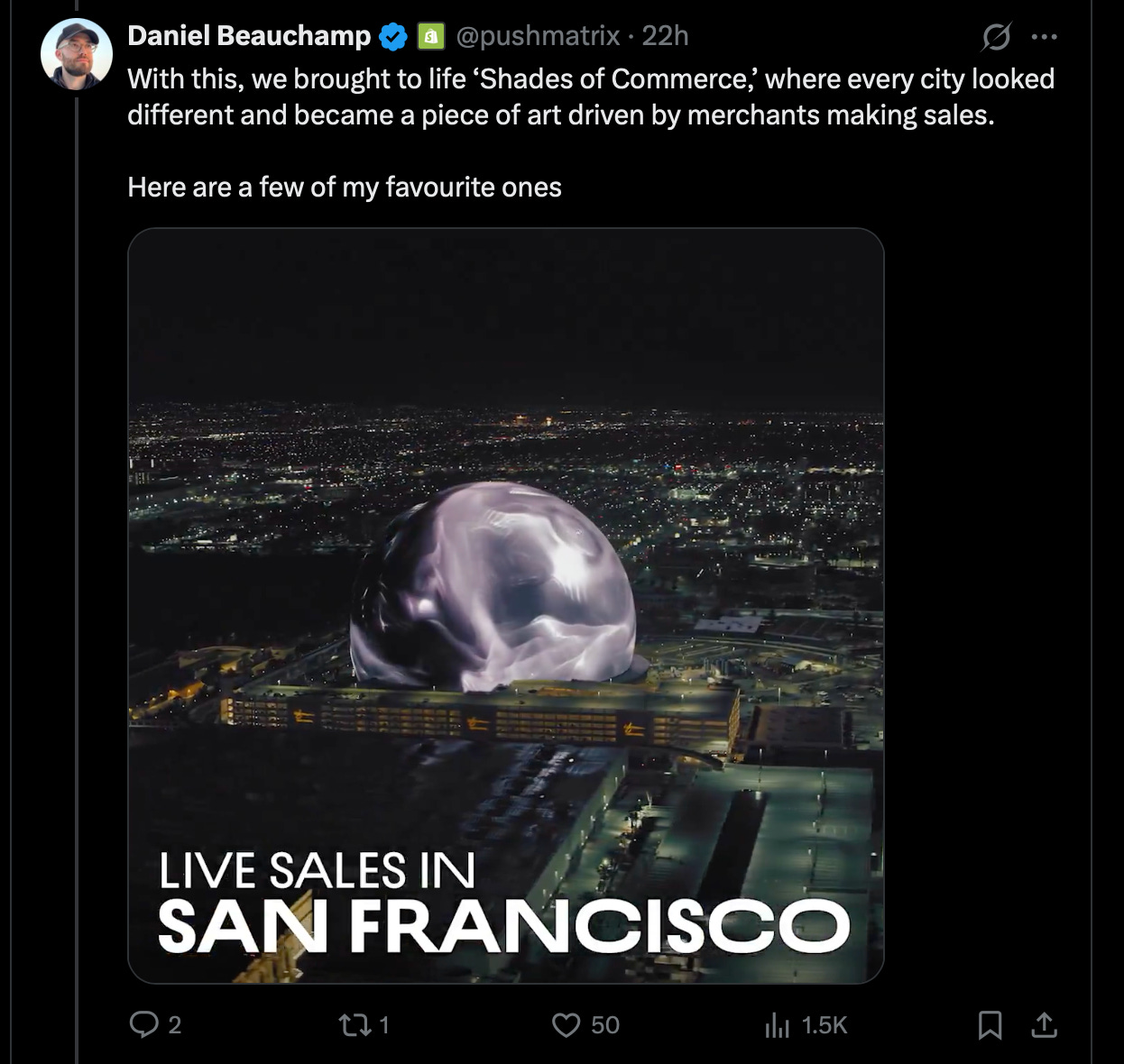
In short… it’s over-the-top, it’s totally extra, and it’s grabbing the internet’s attention during a very crowded cyber-holiday. And if the web experience weren’t enough, they paired it with a live representation of sales for different cities called “Shades of Commerce”.
Each year, I’ve watched the Shopify BFCM 3D globe get more and more ambitious and over-the-top. As a product person, this left me wondering:
Why would Shopify invest so many resources into such a complex engineering project for a single weekend?
And: is the ROI justifiable?
To answer this question, I wanted to understand the history of the globe, all the way back to 2018.
The start of the globe: 2018-2019
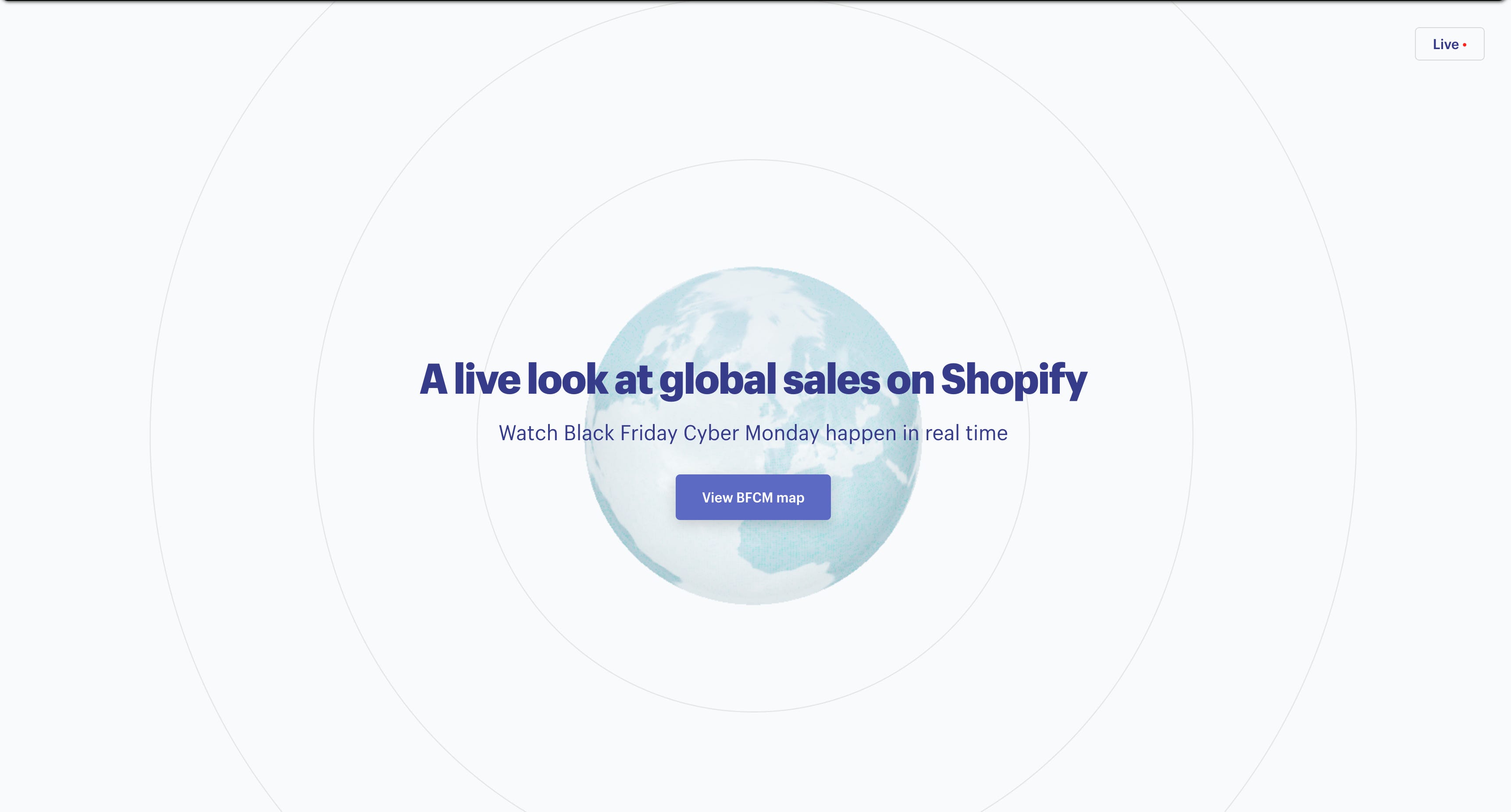
The initial project was pretty humble. Thanks to the Wayback machine, I got a look at the first-ever globe, which Shopify called the “Live Map” from 2018. And thanks to the Google Maps Mania blog, I found screenshot of just 2 metrics: sales per minute and orders per minute.
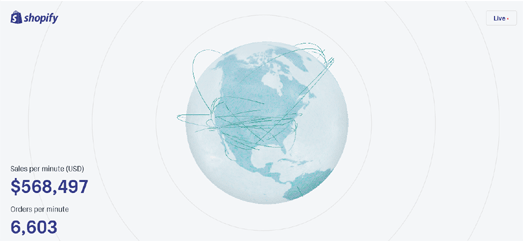
This was back when order volumes could still be represented using an arc.
2019 looked pretty similar to 2018, so I suspect no net-new engineering resources were pooled in.
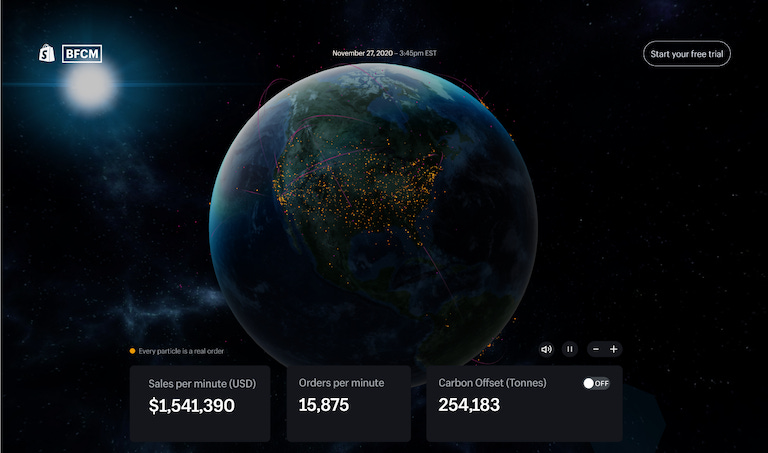
A globe glow-up: 2020
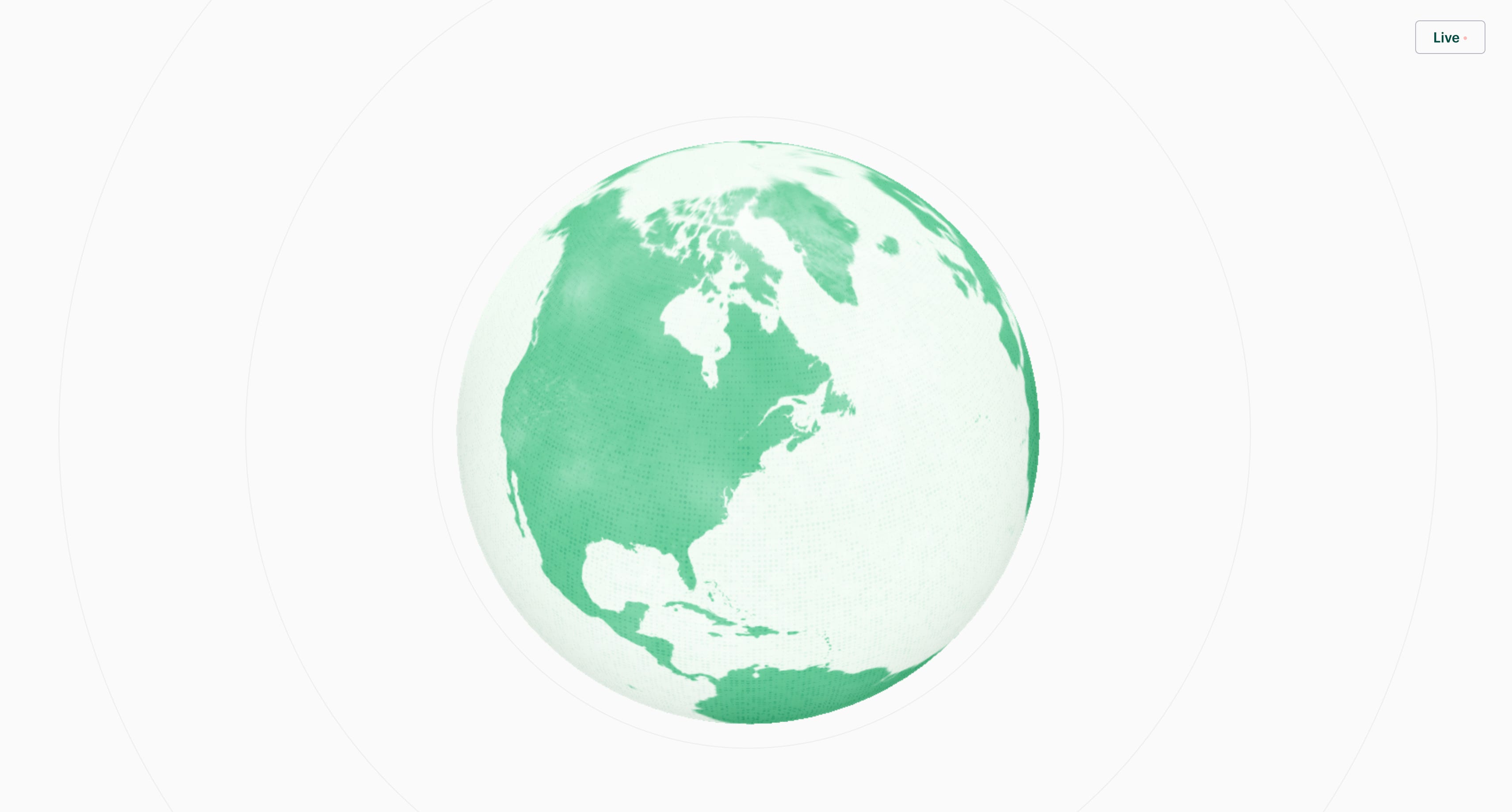
By 2020, the Live Map was rebuilt to handle over 1 million merchants and got a major visual identity glow-up. And Shopify added a new visualization metric: carbon offsets and flash sales (visualized by a lightning bolt whenever a merchant had a flash sale).
At this moment, the globe wasn’t just a fun data visualization project: it was about signalling to the world that despite the Covid-19 pandemic, small entrepreneurship was alive & well.
A major re-architecture: 2021
By 2021, the Globe was being discussed in detail in the Shopify Engineering blog as a technical deep-dive. Because by 2021, with 1.7 million merchants on the platform, a major re-architecture of the globe was accomplished within weeks.
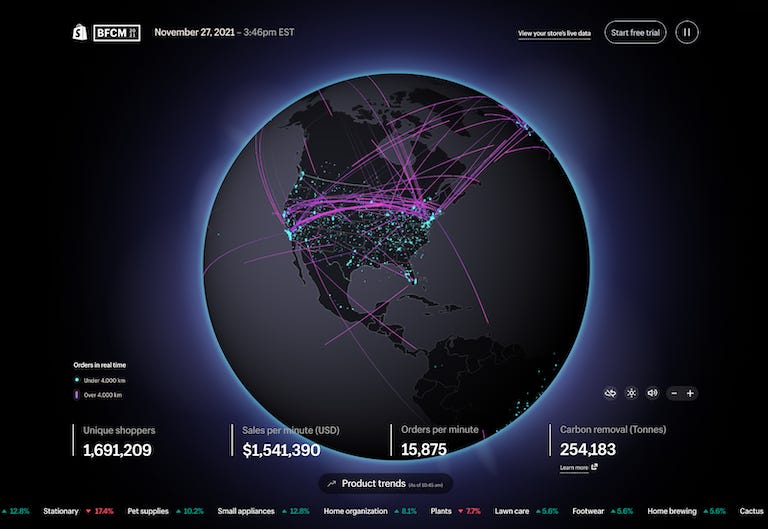
They also added in 2 new metrics:
Product trends (aggregating trendy product categories)
Unique shoppers
Going global: 2023
2023 is when Shopify really started to level up the globe. Shopify shipped a globe with city dots to represent cities with sales in the last 24 hours, and fireworks to represent a merchant’s first sale. They also introduced an easter egg: “airplane mode”, where you could hop on a Shopify airplane flying around the globe for a different POV.
And for the first time, the globe was truly becoming “global” because you could also search individual city stats.

And all of this was shared in a hyper-detailed Shopify Engineering blog post. It was becoming clear: the globe was a technical talent magnet.
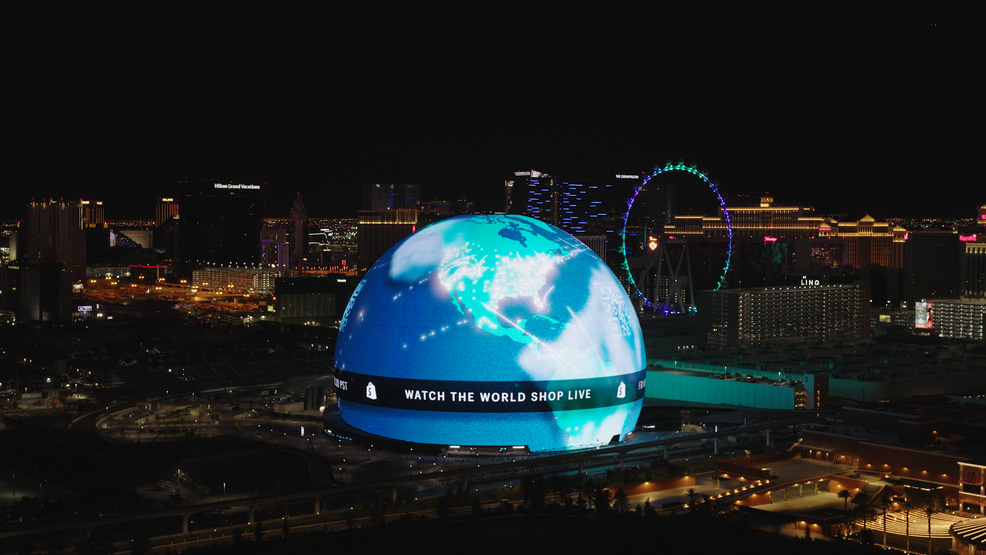
Finally, the globe took on a presence in the physical world by taking a spot in the Las Vegas sphere during BFCM.
More easter eggs & fun: 2024-2025
In 2024 and 2025, the team realized how the fun & quirky “easter eggs” in the globe were actually people’s favourite parts of the globe experience.
Not the stats or the data, just fun surprise moments built into the globe.
In an interview on The Pragmatic Engineer newsletter, Daniel Beauchamp, principal AR/VR engineer explained why that is:
“A big learning last year was that visitors love an easter egg…We wondered why this feature was so liked and realized that while the Live Globe tells the story of entrepreneurship and of Shopify, these fun and delightful moments are really important for people. We took this learning and wrapped it away for the next iteration.” (source: The Pragmatic Engineer)
For 2024, the globe became just one part of a space arcade-like experience. There was interactivity on every switchboard and key in the site, and tons of easter eggs to find on the switchboard.
And finally, this year the team has continued the trend with a 3D globe inside a pinball machine.
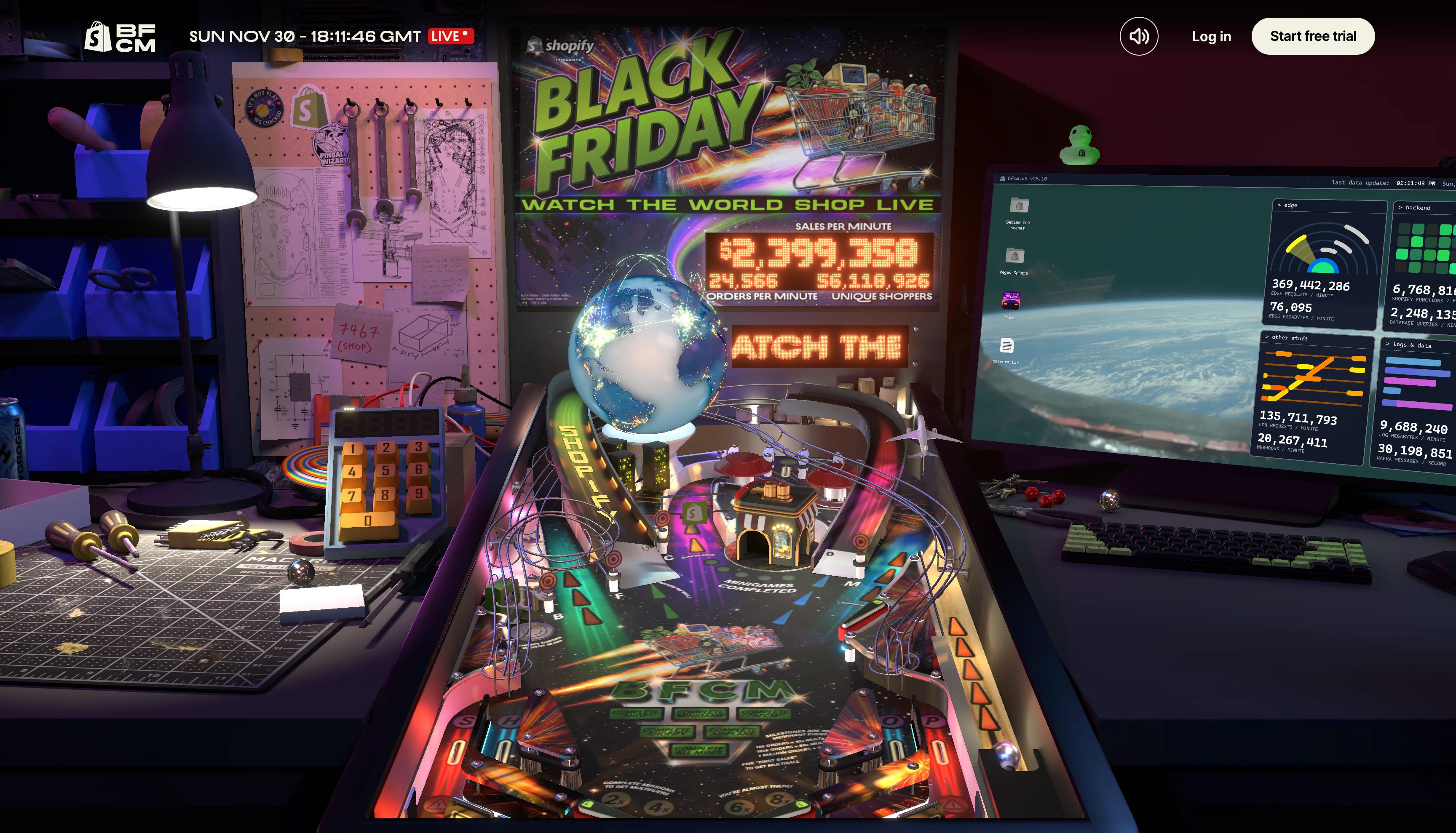
So as we’ve seen, the evolution of this product has gone from cool & practical to maximalist, joyful, and totally over-the-top.
The product has gone from a practical information visualization tool, to a just-for-fun immersive experience with the info-viz baked in.
Which leads me back to my original question…
Building this thing is super technically challenging.
In 2024, according to this post, it took a team of 6 people 2 months to build the globe experience.
Is it super fun? Yes. Does it directly increase sales? Probably not.
So why build it at all?
Because the 3D globe works uniquely for Shopify, in ways that matter more than clicks or ROIs.
1) Earned buzz, every year
On one of the most crowded, sales-heavy, marketing-driven days of the year, Shopify manages to stand out. The globe isn’t just watched, it’s shared. People post screenshots. Hunt for Easter eggs. Journalists reference the stats. Executives tweet it.
It’s not your regular ad campaign. It’s a spectacle. And that’s why it spreads.
2) Proof of scale, without saying a word
This is a brilliant example of “show, don’t tell”. You don’t have to explain that Shopify is global, resilient, and trusted by millions of merchants. The globe shows it, live, in the most elegant way possible.
Even the smallest details, like the fireworks for a merchant’s first sale, communicate the brand ethos around enabling small entrepreneurs.
It’s a “look what you can do on our platform”, but beautiful, interactive, and shareable.
3) A magnet for technical talent
The globe is also a recruiting tool in disguise. If you’re an engineer, designer, or data nerd, this thing says: we care about craft. We’ll green-light ambitious side quests. We’ll ship things just because they’re cool.
Shopify has used it to attract and retain top engineering, design, AR/VR, and product talent. That’s not a side effect, it’s increasingly part of the point.
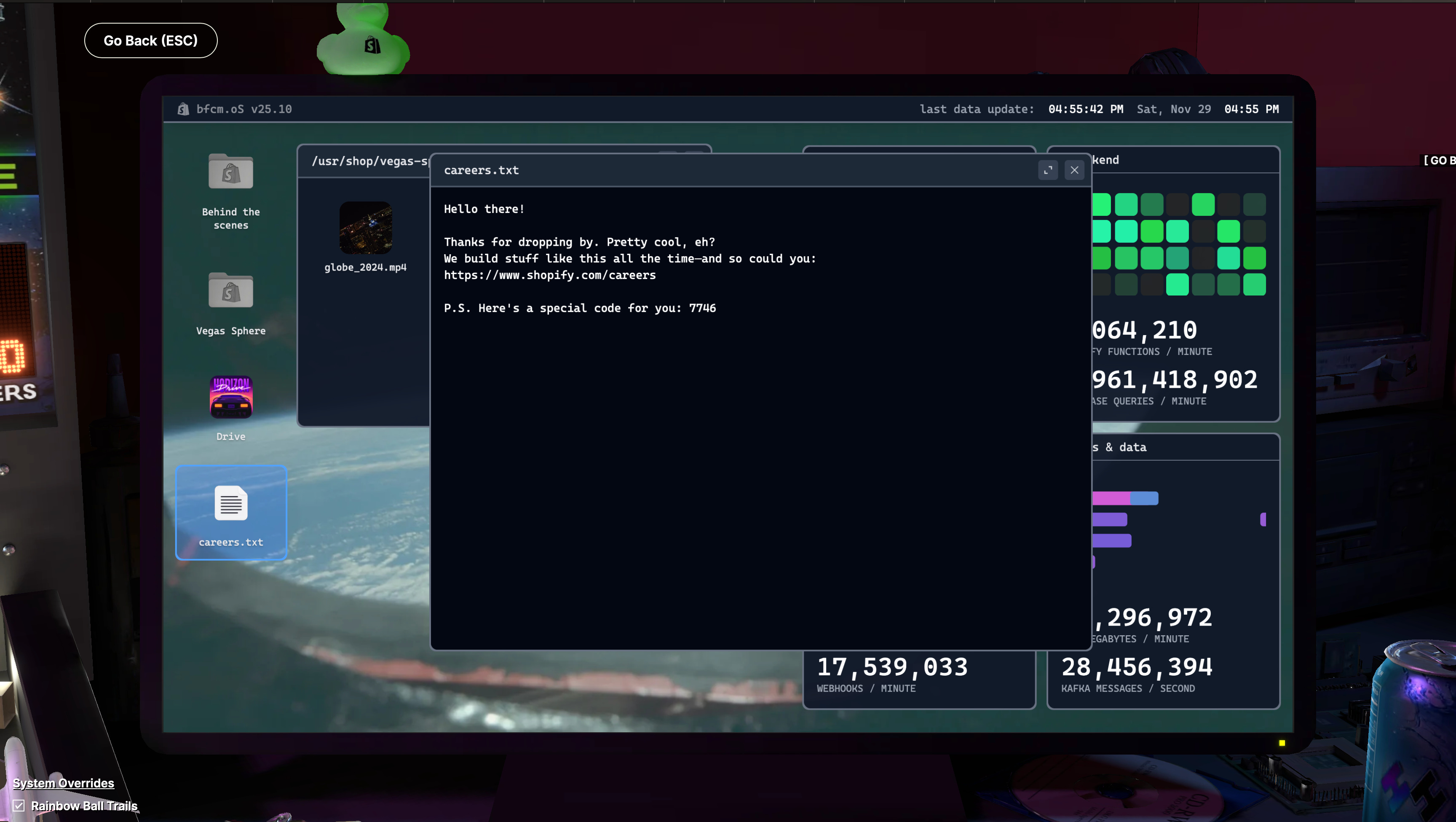
Don’t believe me? In the 2025 3D globe iteration, the computer section of screen is all about recruitment with an old-school careers.txt file on the virtual computer.
4) Sometimes, you just build for joy
Sometimes, when you’re big enough: you can just build for joy’s sake.
Some projects are worth doing because they make people smile. Because they surprise. Because they’re fun.
And increasingly, I’m seeing more and more examples of people building joyful software, just for the sake of it, because vibe coding tools are decreasing the costs of software development.
People are building just for fun.
And building “just for fun” is becoming part of Shopify’s culture to attract technically talented people. As Daniel Beauchamp explains it, “unserious exploration” is a legitimate way to explore new technology in the company.

The spirit of building for the fun is something all Product Builders can embrace: for culture, for team-building, and even for more practical reasons like technical exploration.
💬 Leave a comment or reply to this email:
What’s something your team has built: just for fun, and what was the impact?