


Last week, I wrote about PM mistakes in the age of vibe coding. This week I looked at something more basic, but just as destructive: productivity traps PMs fall into every day.

I went through dozens of Reddit threads where PMs vent about burnout, overwhelm, and feeling unproductive.
The patterns were surprisingly consistent.
Here are three of the biggest productivity mistakes PMs make, and how to fix them.
1. Living in Slack
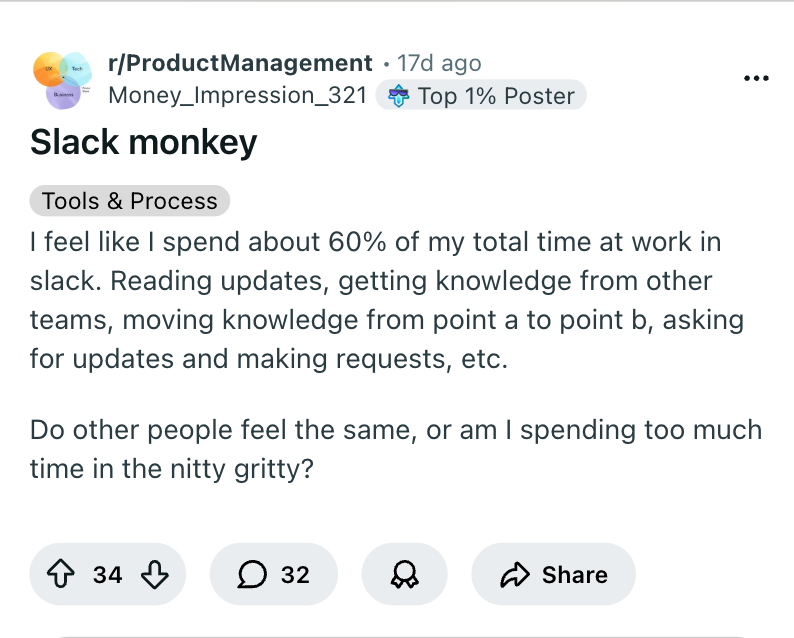
Feeling like a “slack monkey” is so common.
A PM will start their day, gets a ping from sales, engineering asks a clarification question, design asks about priorities. A quick product question turns into a thread. A few timeline/update threads get started.
All of a sudden the day is over. You haven’t done much, but you feel exhausted.
And the trap is subtle because communication is your job.
But communication without boundaries turns PMs into real-time support agents instead of product leaders.
Here’s what to do instead:
Block outcome-based focus time: not just a calendar block. Name the outcome on the calendar block, like: ‘update PRD’, ‘write experiment plan’, or ‘competitor research’.
👉 If the calendar block has no outcome, Slack will win.
Check Slack on a cadence: many strong PMs do not monitor Slack continuously.
My example cadence: morning, once before lunch, once after lunch, end of day.
👉 You’re still responsive, but Slack stops controlling your day.
Stop joining conversations too early: PMs often jump into threads before the team has formed a recommendation. Instead, let the team discuss. Then weigh in when they bring a proposal.
👉 You’ll go from being the decision bottleneck to building an empowered team.
2. Meeting creep
All PMs will also deal with intense meeting fatigue at some point in their career.
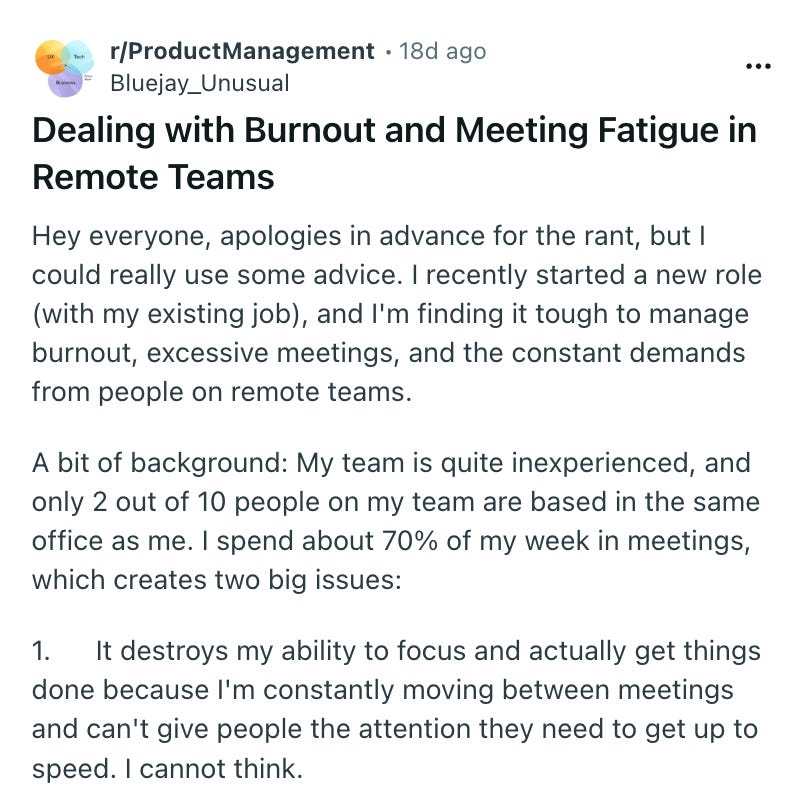
The average PM calendar slowly fills with:
Sprint ceremonies
Stakeholder alignment
Customer calls
Sales support
Design reviews
Weekly 1:1s
Cross-team syncs
Individually, every meeting makes sense. Collectively, they destroy your thinking time.
When your calendar is full, you stop doing the most important PM work of deep problem analysis, writing clear specs, and thinking through long-term strategy.
Here’s what to do instead:
Protect thinking time aggressively: Set up focused time blocks on your calendar before your calendar fills up with meetings.
Kill low-value recurring meetings: Many meetings exist only because they’ve always existed. Delete reoccurring meetings like team syncs or 1-1s that don’t add any value. Try this:
👉 “I feel like we’re well aligned right now. How about we remove this recurring and just sync ad-hoc when something substantive comes up?”
If you're multitasking in a meeting, leave. Multitasking is usually a signal: you are not needed there. Read the meeting notes later.
Push for async conversations: Many “quick calls” could be dealt with async. “Quick calls” are only necessary when the team has tried to resolve an issue async and cannot get aligned. When someone asks: “Can we jump on a quick call?” try this:
👉 “Could you drop a quick Loom or Slack thread explaining the issue?
I’ll review and respond.”
3. AI Learning Fatigue
Learning fatigue was always an issue, but with the intensity of AI development, PMs feel the burnout even more. This post was shared in the Women in Tech subreddit, but I believe it applies to all PMs:
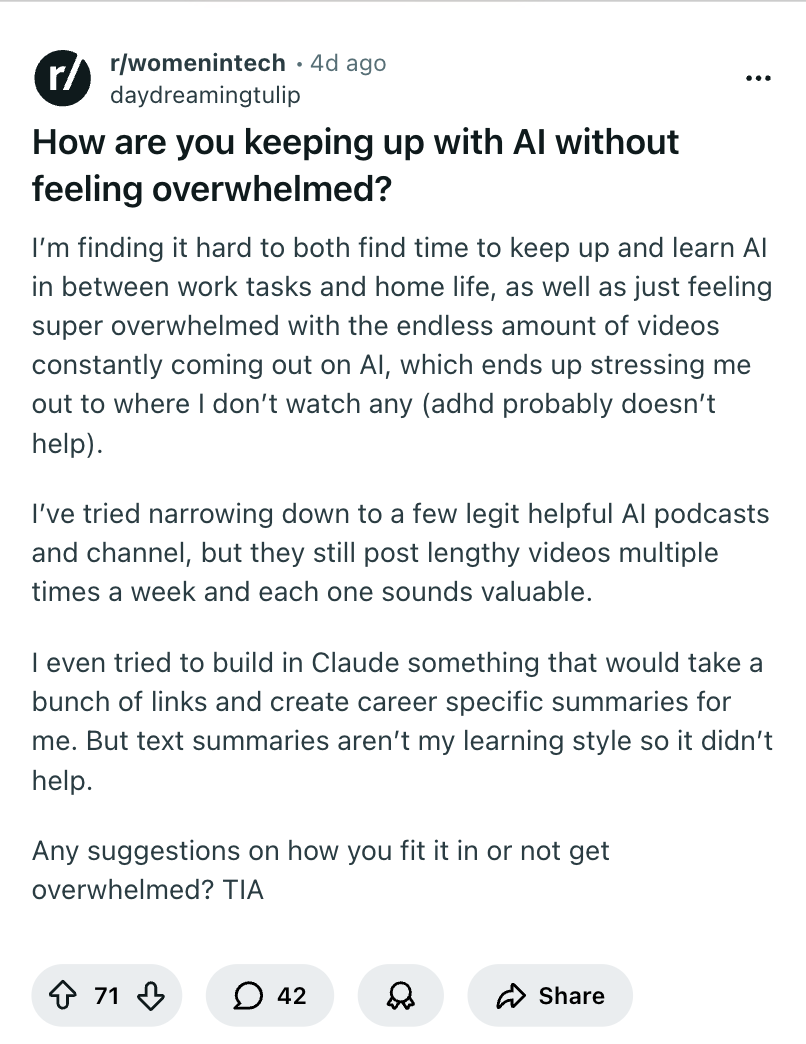
You already have a full-time PM role to keep up with, PLUS you feel compelled to stay on top of the latest AI tools. Often PMs feel this learning has to happen after work, which quickly leads to burnout.
Here’s what to do instead:
Bake the learning into your day job. You don’t need a separate “AI learning program.” Just use AI inside your normal PM work.
Have a new feature you’re working on? Try vibe coding several prototypes to test different approaches.
Completing a new user research project? Build a prototype to test with users.
Researching a new product area? Build an AI automation to do regular competitor research for you.
👉The fastest way to learn AI is not reading about it. It’s building small things constantly.
Set one AI goal per year. For example, I set a goal to “Ship a production feature powered by an LLM”.
👉 A single goal will force you to learn everything that matters.
Learn from the AI enthusiasts in your company. Every company has a few people who are 10x deeper into AI tooling. Ask them to screen share and watch how they work. You’ll learn a ton in 30 minutes and it’ll be company-specific tips.
Final Thoughts
Slack activity, meetings, and constant learning all feel productive. But the real leverage of a PM comes from clear thinking & clear decision-making.
And that requires protecting your focus time.
💬 How are you protecting your focus time?